
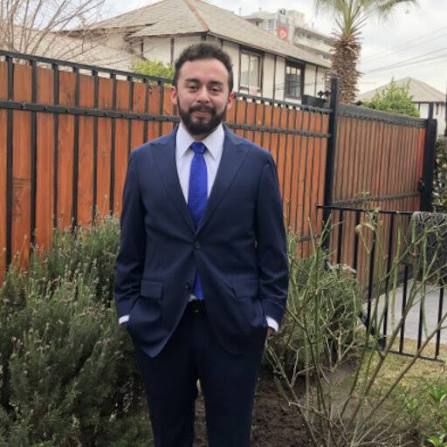
Diego Garcia Ovalle : Spin and orbital angular momentum in periodic solids: From nonmagnetic to magnetic materials
Speaker: Diego Garcia Ovalle, Postdoctoral Fellow, Sherbrooke University
Location : LPS Theo Coffee Room + Zoom
Abstract:
Over the past few years, the study of the electron’s degrees of freedom have received a major interest in condensed matter, both theoretically and experimentally. In particular, investigating the spin and the orbital angular momentum is a source of a fascinating landscape of new physics in periodic systems, where materials that are effectively nonmagnetic and even composed with light elements can be used for the new generation of more efficient electronic devices.
In this talk, I will explain from the theory point of view how these two fundamental properties of the electron have a dramatic impact on the nonequilibrium responses of quantum materials. Firstly, in the nonmagnetic case, I will describe how the angular momentum of the electron can be connected to the nonlinear Hall effect in noncentrosymmetric materials. When moving forward to analyze spin and orbital transport exclusively, I will focus on distinguishing the role of spin-orbit coupling and the Rashba effect on the spin and orbital-to-charge conversion in materials without inversion symmetry, which are key figures of merit for the optimization of the basic structures in data storage. Secondly, we will switch the gear to ferromagnetic materials to discuss two distinct effects in low symmetry crystals that emerge from the trigonal warping of the Fermi surface: A special class of spin-orbit torque and the so-called crystalline in-plane Hall effect. Last but not least, I will present an important prospect of my work that aims to exploit the spin and the orbital angular momentum in antiferromagnets and altermagnets from surface engineering. Here, I will illustrate the instance of the nonequilibrium spin polarization reported very recently, and its potential extension to superconductivity. Exploring nonequilibrium responses arising on the spin or the angular momentum serve not only as a probe of the electronic structure of quantum materials, but also as tools that might shed light on how to control them externally for novel applications in spin-orbitronics.