
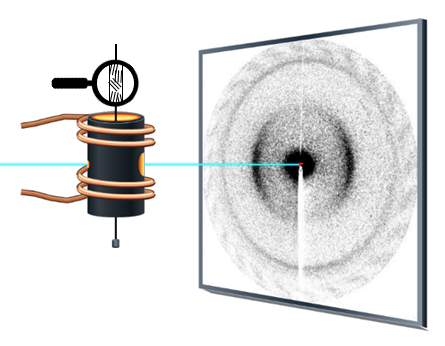
Scientists from the Laboratoire de Physique des Solides (CNRS/Université Paris-Saclay) have developed an induction furnace that makes it possible to study in situ, by X-ray scattering, the transformation of lignin-based fibers into carbon fibers, at temperatures of up to 2000 °C.
Carbon fibers are highly sought-after materials for their lightness and mechanical strength. They are used in many fields, including wind turbine blades, hydrogen tanks, vehicles and aeronautics. Their production, however, relies mainly on petrochemical resources.
Lignin, a polymer naturally present in plants, represents a promising renewable alternative for producing more sustainable carbon fibers. But how can this plant-based material be turned into fibers with good mechanical properties?
One of the keys lies in the organization of the carbon nano-domains that make up the fibers: their orientation plays an important role in the final properties of the material. To understand how this organization takes shape during the transformation, we study the fibers directly while they are being heated, using X-ray scattering.
As part of Lucie Diéval’s PhD thesis, a specific induction furnace was developed at the laboratory. It makes it possible to heat the fibers up to 2000 °C while performing in situ measurements. This approach allows the structural transformations to be tracked throughout carbonization, and provides a better understanding of the mechanisms that lead to the formation of carbon fibers from lignin.
Contributors:
Lucie Diéval, Jérémie Sanchez, Thomas Ammendola, Jérôme Guiguand (ISMO), Stéphane Cabaret, Stéphan Rouzière, Fabrice Quenault, Pierre-Antoine Albouy, Victor Baledent and Pascale Launois.
Laboratoire de Physique des Solides (CNRS/Université Paris-Saclay) and Institut des Sciences Moléculaires d’Orsay (ISMO).
Funding:
Lucie Diéval’s PhD is funded by a CNRS–Imperial College contract entitled “Spinning sustainable carbon fibers for the energy transition”.
The development of the furnace benefited from a specific action of the laboratory, a support scheme for doctoral students of the Integrative Institute of Materials, and the support of the “Physics of Waves and Matter” thematic axis of Université Paris-Saclay.
Référence
No publication yet
Contact
Pascale Launois – pascale.launois@cnrs.fr