

| Physicists have shown that adding liquid droplets to a soft solid allows for precise control of its energy dissipation, revealing a hybrid behavior between a gel and an emulsion. |
Hybrid soft materials, consisting of liquid droplets dispersed in an elastic solid matrix, open the way to new mechanical properties. But understanding their behavior precisely remains a challenge: how can a material be both elastic like a solid… and dissipative like a liquid?
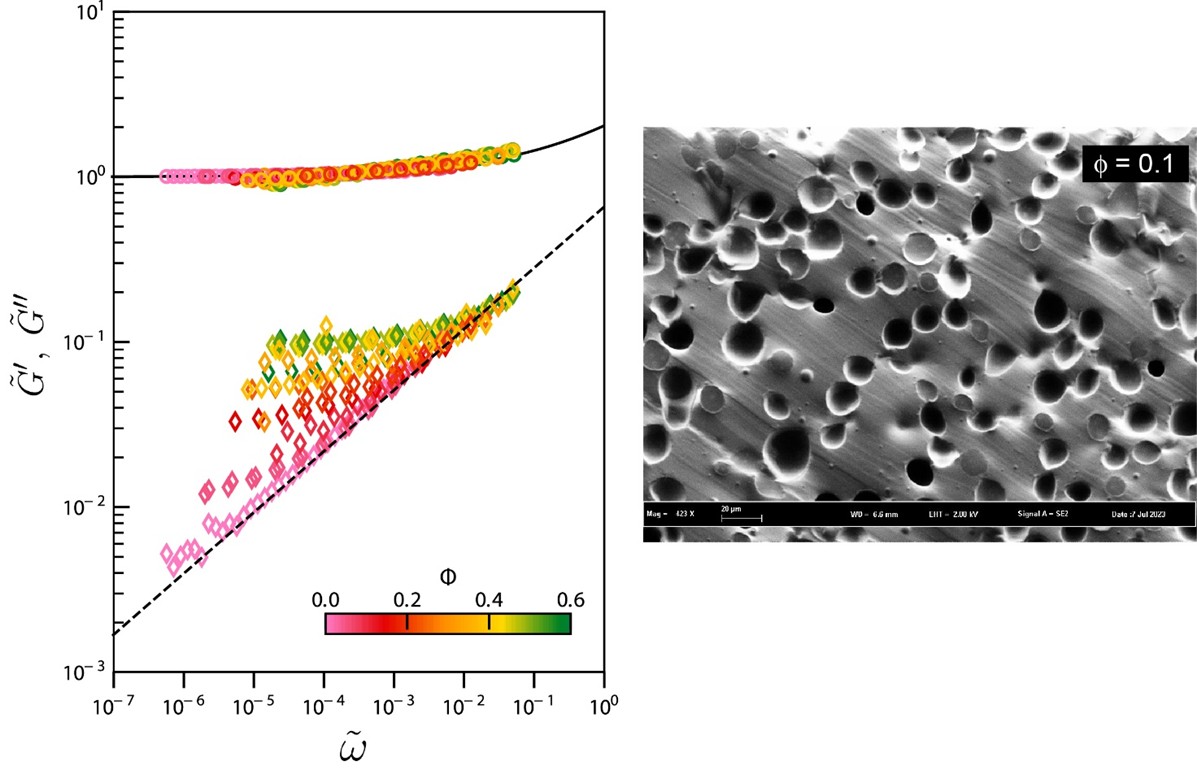
Researchers recently studied these “solid emulsions,” formed of polyethylene glycol (PEG) droplets encapsulated in a silicone (PDMS) matrix, with the aim of understanding how these liquid inclusions alter the material’s mechanical response, while controlling the two effects separately. Their experiments revealed atypical behavior. Indeed, while at high frequencies (in experiments where the material is periodically sheared), the system behaves like a conventional solid dominated by its elastic matrix, at low frequencies, however, the liquid droplets take over and introduce additional energy dissipation, profoundly altering the viscoelastic response (see figure). To describe this duality, the researchers developed an atypical model based on “fractional rheology.” This framework allows for a simple capture of the transition between solid and liquid behavior. This theoretical model enabled them to show that dissipation increases linearly with the amount of liquid, independent of frequency—a behavior typically observed in emulsions, and which is found here in a solid material.
The researchers thus demonstrate that these composites lie at the boundary between gels and emulsions. They thereby open up new possibilities for designing materials with tailor-made mechanical properties, particularly for applications in adhesion, energy absorption, or flexible electronics. These results are published in the journal Soft Matter.
Contribution
Laboratoire physique des solides (LPS, CNRS / Université Paris-Saclay)
Service de physique de l’état condensé (SPEC, CEA/CNRS)
Sciences et Ingénierie de la Matière Molle (SIMM, CNRS/ESPCI Paris-PSL/Sorbonne Université)
Contact
Christophe Poulard, Professeur des universités de l’Université Paris-Saclay au Laboratoire de Physique des Solides (LPS) : christophe.poulard@universite-paris-saclay.fr
Références :
Rheological response of soft solid/liquid composites. Elina Gilbert, Anniina Salonen, Christophe Poulard, Soft Matter, 2025,21, 8999-9007. Publié le 31 octobre 2025.
DOI : 10.1039/D5SM00973A