
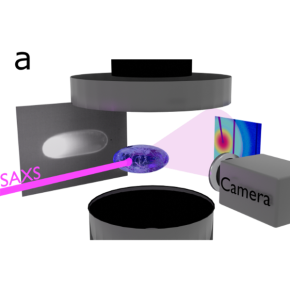
Figure: a) Schematic illustration of the setup to monitor EISA in levitated droplets. b) images of the shrinking droplet (top) and the corresponding 2D SAXS patterns (bottom) acquired at two different times, close to the beginning and the end of the process.
| A team of researchers, including scientists from the Laboratoire de Physique des Solides (CNRS/Université Paris-Saclay), has now identified a key factor controlling this process. The researchers studied silver nanorods—tiny rod-shaped particles—dispersed in water and stabilized by a surfactant called CTAC (cetyltrimethylammonium chloride), which forms a crystalline phase at high concentration. |
When a liquid containing nanoparticles dries, the particles can spontaneously organize into highly ordered structures. This phenomenon, known as evaporation-induced self-assembly (EISA), is widely used to fabricate advanced materials. Yet, how this organization actually takes place during drying remains poorly understood.
A team of researchers, including scientists from the Laboratoire de Physique des Solides (CNRS/Université Paris-Saclay), has now identified a key factor controlling this process. The researchers studied silver nanorods—tiny rod-shaped particles—dispersed in water and stabilized by a surfactant called CTAC (cetyltrimethylammonium chloride), which forms a crystalline phase at high concentration.
To follow the particles as the droplet dried, the team used an innovative approach based on levitated droplets. The droplets are held without contact, allowing the researchers to observe their evolution in real time while avoiding interactions with a solid surface. Using time-resolved small-angle X-ray scattering (SAXS), they could track how the nanoparticles progressively organized during evaporation.
The results challenge a common assumption about nanoparticle self-assembly. It is generally thought that the increasing concentration of nanoparticles caused by evaporation is the main factor driving their organization. Instead, the study shows that the initial concentration of CTAC is the key parameter controlling whether ordered structures form. This effect is stronger than the influence of the nanoparticle concentration—and even of the shape of the particles.
The researchers found that CTAC plays two successive roles during drying. At the beginning, CTAC molecules form small aggregates called micelles. These micelles modify the interactions between nanoparticles, effectively bringing the nanorods together and promoting the formation and growth of ordered assemblies. As evaporation continues, the concentration of CTAC increases and a crystalline phase appears. The appearance of this solid phase stops the nanoparticles from reorganizing and effectively “freezes” the structure in place.
The experiments also reveal that nanoparticle ordering begins before the droplet has completely dried and occurs throughout its volume. At larger scales, the nanorods progressively adopt a radial organization, following the geometry of the shrinking droplet.
By combining X-ray scattering with electron microscopy and microbeam analyses, the researchers were therefore able to reconstruct how nanoparticle organization develops from the early stages of evaporation to the final material.
These findings provide new guidelines for controlling and reproducing the assembly of nanoparticles into ordered structures. Such control could help in the development of plasmonic materials, photonic structures and other functional nanomaterials with tailored optical and electronic properties.
Financement
ANR CODENAME, ANR 2Rods and ANR MetaTRAP
Research team
The study brings together researchers from the Laboratoire de Physique des Solides (CNRS/Université Paris-Saclay), the SWING beamline at Synchrotron SOLEIL, the Institut Charles Sadron (CNRS/Université de Strasbourg) and CIC nanoGUNE (Donostia-San Sebastián, Spain).
Reference
Claire Hotton, Jaime Gabriel Trazo, Evgeny Modin, Arnaud Bardouil, Nika Kutalia, Jules Marcone, Rahul Nag, Claire Goldmann, Erwan Paineau, Andrey Chuvilin, Marianne Impéror-Clerc, Thomas Bizien, Doru Constantin, Cyrille Hamon, Nano Letters (2026), 26 (25): 8274–8281, https://doi.org/10.1021/acs.nanolett.6c01619
Contact at LPS
Erwan Paineau : erwan-nicolas.paineau-lanone@cnrs.fr
Marianne Impéror-Clerc : marianne.imperor@cnrs.fr
Cyrille Hamon : cyrille.hamon@cnrs.fr.