
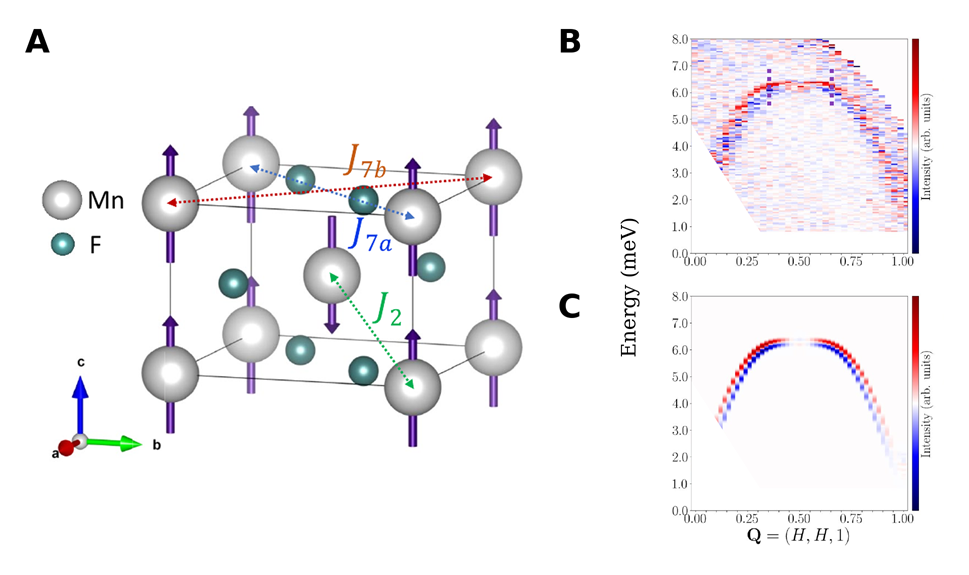
Physicists from the Laboratoire de Physique des Solides (CNRS/Université Paris-Saclay) and the Laboratoire Léon Brillouin (CEA/CNRS/Université Paris-Saclay), together with Oak Ridge National Laboratory and the University of Windsor, show using polarized inelastic neutron scattering that MnF₂, a textbook antiferromagnet known since the 1950s, is in fact an altermagnet. The decisive signal: a nonzero magnon chirality with opposite sign for the two excitation branches.
Altermagnets form a third family of magnetically ordered materials. Their net magnetization vanishes, as in an antiferromagnet, yet their band structure shows a symmetry-enforced spin splitting, as in a ferromagnet, which makes them attractive for spintronics. So far, spectroscopic evidence relied mostly on angle-resolved photoemission (MnTe, CrSb): altermagnetism had only been visualized through electronic degrees of freedom.
It should also show up in spin excitations: without spin-orbit coupling, the two magnon modes carry a chirality ±1 and their energies differ. Measuring this chirality is the most direct signature, but the resolution of RIXS (~10 meV) cannot separate the two modes.
The researchers used inelastic neutron scattering with polarization analysis on a single crystal of MnF₂ (antiferromagnetic order below TN ≈ 67 K, Mn²⁺ ions of spin 5/2, hence very weak spin-orbit coupling). On the HYSPEC spectrometer (SNS, Oak Ridge), they first observe a well-resolved splitting of the magnon branch, about 0.18 meV at most for a 7 meV bandwidth, mainly due to long-range dipolar coupling. A Heisenberg-model fit shows that the crystal symmetry is reproduced only when neighbors up to the seventh shell are included, where two distinct couplings, J₇ₐ and J₇ᵦ, are allowed: a necessary condition for an altermagnetic splitting.
The key result comes from the polarized measurements, on a sample that is 85 ± 5 % single-domain. Subtracting the intensities measured for +P and −P isolates a chiral term that is nonzero, maximal near H ≈ 0.35 along (H, H, 1), of opposite sign between the upper and lower branches, and vanishing at the zone boundary, as expected from the d-wave symmetry of MnF₂. Two independent methods of polarization reversal give the same results, ruling out an instrumental artifact.
This signal, 5 to 11 % of the total intensity, probes differences of only a few μeV between J₇ₐ and J₇ᵦ, far finer than what the dispersion alone can resolve. Polarized neutrons thus provide a benchmark to identify new altermagnets and their chiral magnons.
Contributors:
Quentin Faure*, Dalila Bounoua*, Victor Balédent*, Arsen Gukasov, V. Ovidiu Garlea, Afonso Ribeiro, Jeffrey G. Rau, Sylvain Petit, Paul McClarty
Laboratoire de Physique des Solides (CNRS/Université Paris-Saclay)
Laboratoire Léon Brillouin (CEA/CNRS/Université Paris-Saclay)
Institut universitaire de France (IUF)
Neutron Scattering Division, Oak Ridge National Laboratory (États-Unis)
Department of Physics, University of Windsor (Canada)
Funding
CNRS, CEA, ANR (ALTEROSPIN, ANR-24-EXSP-0002), French Federation of Neutron Scattering (2FDN), NSERC (Canada), DOE Office of Science (SNS, Oak Ridge). Sample selection, characterization and alignment: MORPHEUS platform at LPS.
Reference
Q. Faure*, D. Bounoua*, V. Balédent*, A. Gukasov, V. O. Garlea, A. Ribeiro, J. G. Rau, S. Petit, P. McClarty, Altermagnetism revealed by polarized neutrons in MnF₂, Science 394 (6823), 544–548 (2026), https://doi.org/10.1126/science.aec2602
Contact
victor.baledent@universite-paris-saclay.fr